How to Choose a Probiotic: 7 Things to Look For | Grisso
Aug 6, 2026 Grisso Wellness TeamStanding in the supplement aisle (or scrolling Amazon), you're bombarded with choices: 50 billion CFU, 100 billion CFU, 15 strains, 3 strains, refrigerated, shelf-stable, enteric-coated, spore-forming — the list goes on.
How do you cut through the noise?
After reviewing the clinical literature and analyzing dozens of probiotic products, we've identified 7 criteria that actually determine whether a probiotic will work for you — and several marketing tactics that are pure noise.
Here's your definitive buying guide.
1. Strain Specificity: Know Exactly What's in the Bottle
This is the single most important factor, and it's also the most commonly overlooked.
What to look for: The label should name each strain using the full scientific designation — genus, species, and strain code. For example:
- ✅ Bacillus coagulans BC99™
- ✅ Lactobacillus rhamnosus GG
- ✅ Bifidobacterium infantis 35624
- ❌ "Probiotic blend" (no strain names)
- ❌ "Lactobacillus species" (which species?)
- ❌ "Active cultures" (meaningless)
Why it matters: Different strains of the same species can have completely different effects. Lactobacillus acidophilus NCFM has been clinically studied for lactose digestion, while Lactobacillus acidophilus LA-5 has been studied for vaginal health. They're the same species but do different things. If the label doesn't name the strain, you can't match it to research — which means the manufacturer either doesn't know or doesn't want you to know.
Red flag: "Proprietary blend" with no strain breakdown. This usually means they're using cheap, untested strains and hiding behind a proprietary label.
2. CFU Count: More Isn't Always Better, But Less Is Usually Worse
CFU (colony-forming units) tells you how many live bacteria are in each serving. Here's the evidence-based guidance:
| CFU Range | Best For | Evidence Level | |-----------|----------|---------------| | 1-10 billion | General maintenance, immune support | Moderate for daily wellness | | 10-50 billion | Mild digestive issues, post-antibiotic recovery | Good for targeted support | | 50-100 billion | IBS, chronic bloating, significant dysbiosis | Strong clinical evidence | | 100+ billion | Severe digestive concerns, clinical-grade support | Growing evidence for efficacy |
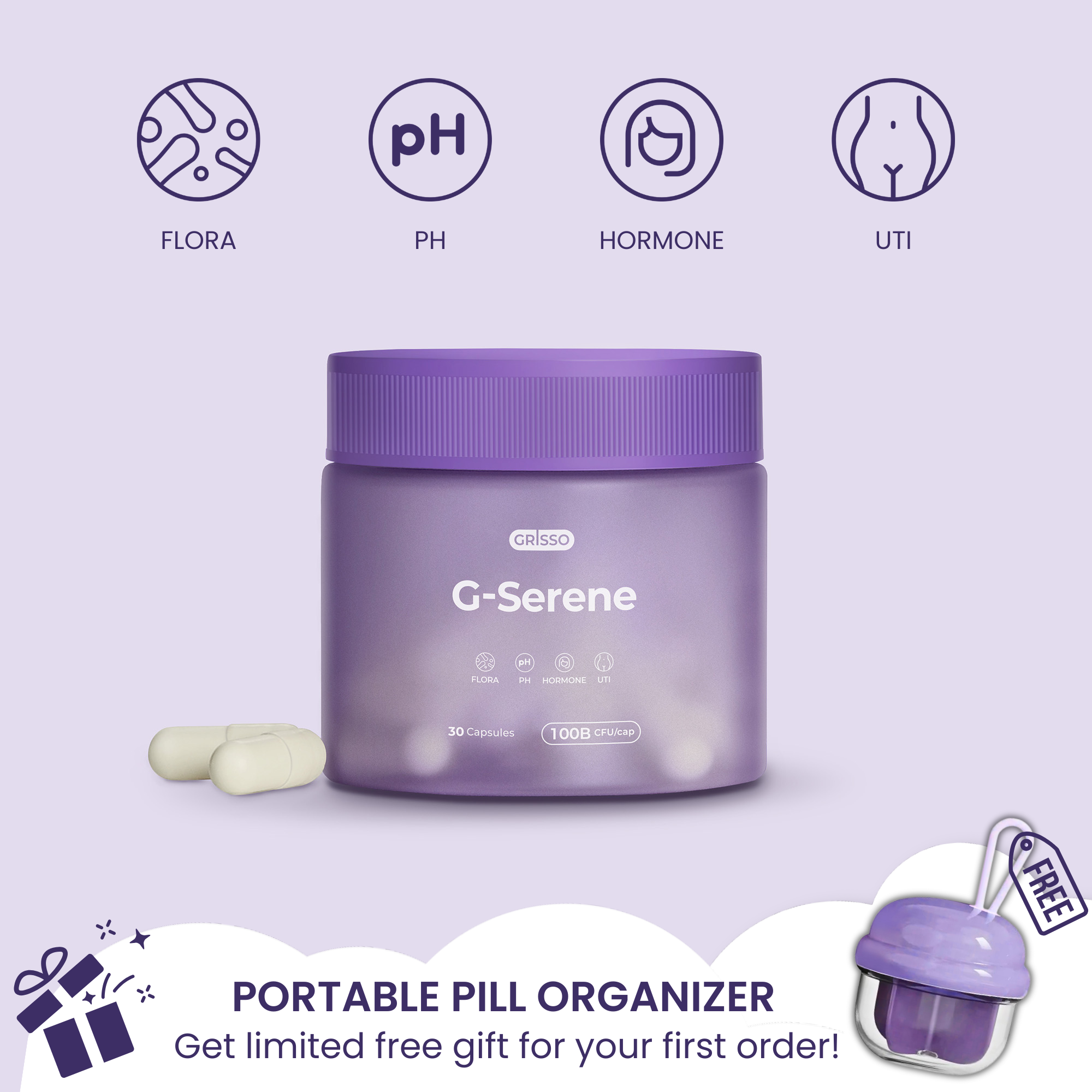
What to look for: For meaningful digestive health benefits, aim for 50-100 billion CFU. This is the range where most clinical trials show statistically significant results. Our entire Grisso line delivers 100 billion CFU per serving — G-Serein for stress/sleep, G-Serene for women's health, and G-Sylph for gut/digestion.
The CFU trick to watch for: Some brands list CFU "at time of manufacture" rather than "at expiration." Probiotics die over time, so a product that starts with 100 billion CFU might have 10 billion by the time you buy it. Always look for CFU at expiration — this is what you're actually getting.
3. Acid Survival: Can the Bacteria Actually Reach Your Gut?
This is where most probiotics fail silently. Here's the uncomfortable truth:
Up to 90% of standard probiotic bacteria die in stomach acid.
Your stomach pH is approximately 1.5-3.0 — acidic enough to dissolve metal. Most Lactobacillus and Bifidobacterium strains are not naturally acid-resistant. When you swallow them, the vast majority are destroyed before they reach your intestines.
What to look for:
- Spore-forming strains (like Bacillus coagulans / our BC99™): These naturally form a protective spore coating that survives stomach acid, germinates in the intestine, and colonizes. This is the gold standard for acid survival — no special coating or technology needed.
- Enteric-coated capsules: These are designed to dissolve in the intestine rather than the stomach. They help non-spore strains but aren't 100% reliable.
- Acid-tested strains: Some manufacturers test their strains for acid survival and provide data. If they do, it's usually on their website.
What to avoid: Any probiotic that doesn't address acid survival at all. If they're not talking about it, their bacteria probably aren't surviving.
4. Single Strain vs. Multi-Strain: The "More Is Better" Myth
Many consumers assume that more strains = better product. The evidence doesn't support this universally.
Single-strain products (1 strain):
- Easier to match to specific clinical evidence
- No risk of inter-strain competition
- Clearer dosing — you know exactly how much of each strain you're getting
- Best when you have a specific, targeted concern (e.g., IBS, antibiotic recovery)
Multi-strain products (2-10+ strains):
- May offer broader coverage for general gut health
- Some strains work synergistically
- BUT: strains can compete with each other, reducing overall efficacy
- BUT: many multi-strain products use tiny amounts of each strain to pad the label
What to look for: If you choose a multi-strain product, make sure each strain is listed with its individual CFU count (not just the total). If a "15-strain" product has 50 billion total CFU, each strain is getting only ~3 billion — well below the effective dose for most strains.
Our philosophy at Grisso is to use a single, extensively researched strain (BC99™) at a high dose (100 billion CFU) rather than spreading thin across many strains. This ensures you're getting a clinically meaningful dose of a strain with proven efficacy.
5. Storage and Stability: Will the Bacteria Still Be Alive When You Take Them?
Probiotics are living organisms. They die over time, and they die faster under certain conditions.
What to look for:
- Expiration date with guaranteed CFU: The CFU count should be guaranteed through the expiration date, not just at manufacture.
- Storage requirements: Check whether refrigeration is needed. Spore-forming strains are naturally shelf-stable. Non-spore strains typically need refrigeration.
- Packaging: Look for dark or opaque bottles that protect from light, and moisture-proof seals (desiccant packets inside are a good sign).
What to avoid:
- Products stored on open shelves at room temperature when they require refrigeration
- Products without expiration dates
- Products in clear plastic bottles (light degrades probiotics)
6. Clean Labels: What Should NOT Be in Your Probiotic
The supplement industry is loosely regulated. Many probiotic products contain ingredients that can cause problems, especially for people with sensitive digestion:
Avoid these common filler ingredients:
| Ingredient | Why It's Problematic | |-----------|---------------------| | Maltodextrin | Can feed harmful bacteria; derived from GMO corn | | Artificial colors | No functional purpose; potential allergens | | Titanium dioxide | Whitening agent banned in the EU; potential safety concerns | | Excessive binders | Can interfere with disintegration and absorption | | Dairy/Lactose | Common allergen; many people seeking probiotics are lactose-sensitive | | Gluten | Major allergen; especially problematic for IBS patients |
What a clean label looks like: The supplement should contain the probiotic strain(s), a capsule (preferably vegetarian/HPMC), and perhaps a prebiotic fiber. That's it. Our G-Sylph, for example, contains BC99™ probiotic in a vegetable capsule with minimal excipients — no fillers, no artificial ingredients, no common allergens.
7. Third-Party Testing and Manufacturing Quality
Because the FDA doesn't rigorously test supplements, third-party verification is your best assurance of quality.
What to look for:
- GMP certification (Good Manufacturing Practice) — ensures the facility meets basic quality standards
- NSF or USP verification — independent testing organizations that verify label claims
- FDA-registered facility — the manufacturer should be registered with the FDA
- Certificate of Analysis (CoA) — some brands publish batch-specific testing results showing CFU counts and contaminant testing
At Grisso, all products are manufactured in our own FDA-registered, cGMP-certified facility (DFX MANUFACTORY INC., Ontario, CA) and carry NSF, Non-GMO, and FSSC certifications. This level of manufacturing transparency is rare in the probiotic industry.
What to Ignore: Marketing Tricks That Don't Matter
Now that you know what to look for, here's what to stop worrying about:
- "Delayed release" claims without data — Sounds impressive, but without published dissolution testing, it's just a claim
- "Patented" without specifying what's patented — A patent on packaging doesn't mean the product works
- Number of Amazon reviews — Easily manipulated; not a quality indicator
- "Doctor-formulated" — Meaningless without knowing which doctor and what their credentials are
- Price as a quality indicator — Some of the most expensive probiotics have the weakest clinical evidence; some of the best-value ones are scientifically sound
- "Made in USA" — Where it's manufactured matters less than how it's manufactured. A GMP-certified facility anywhere beats an uncertified facility in the US.
The 60-Second Probiotic Buying Checklist
Print this, screenshot it, or bookmark this page:
- [ ] Strain named? Full genus + species + strain designation
- [ ] CFU count adequate? 50-100 billion for digestive health
- [ ] CFU guaranteed at expiration? Not just at manufacture
- [ ] Acid survival addressed? Spore-forming or enteric-coated
- [ ] Clean label? No unnecessary fillers or allergens
- [ ] Third-party tested? GMP, NSF, or equivalent
- [ ] Storage appropriate? Matches the product's requirements
If a product checks all 7 boxes, it's a quality probiotic worth trying. If it fails on 2 or more, move on.
Grisso's Probiotic Lineup: How We Measure Up
| Criterion | G-Serein | G-Serene | G-Sylph | |-----------|----------|----------|---------| | Strain | BC99™ (named) | BC99™ (named) | BC99™ (named) | | CFU | 100 billion | 100 billion | 100 billion | | Acid survival | Spore-forming ✅ | Spore-forming ✅ | Spore-forming ✅ | | Prebiotic | — | ✅ Included | — | | Fillers | None | None | None | | Manufacturing | FDA/cGMP/NSF | FDA/cGMP/NSF | FDA/cGMP/NSF | | Storage | Shelf-stable | Shelf-stable | Shelf-stable | | Target | Stress & sleep | Women's 4-in-1 | Digestion & regularity |
Get all three in our Daily Routine Bundle and save 15%. Use code BLOG10 for an additional 10% off.
These statements have not been evaluated by the Food and Drug Administration. This product is not intended to diagnose, treat, cure, or prevent any disease. Consult your healthcare provider before starting any supplement regimen.
References
- Sanders, M.E., et al. (2018). Probiotics and prebiotics in intestinal health and disease. Nature Reviews Gastroenterology & Hepatology, 15(10), 598-609.
- Hill, C., et al. (2014). The International Scientific Association for Probiotics and Prebiotics consensus statement on the scope and appropriate use of the term probiotic. Nature Reviews Gastroenterology & Hepatology, 11(8), 506-514.
- Khemariya, P., et al. (2016). Bacillus coagulans as a probiotic: Characteristics and applications. Journal of Applied Microbiology, 121(5), 1311-1321.
- Friedman, M. (2015). Antibiotic-resistant bacteria and foodborne illnesses. Journal of Food Protection, 78(1), 169-181.
- Binda, S., et al. (2020). Criteria to qualify microorganisms as "probiotic" in foods and dietary supplements. Frontiers in Microbiology, 11, 1662.